
Finding Chula Vista Residents
No single file lists every household. A useful Chula Vista resident lookup starts with the clue in hand. Got an address? Pull the parcel and its assessment record first. A known owner points instead to the county recorder's grantor and grantee index. Checking your own registration takes the voter lookup. Court names surface in a case search. For past residents, printed directories, census schedules, newspapers, deeds, maps, and probate files each cover a different era.
Every source answers one narrow question. A parcel identifies land and a recorded party. It cannot name everyone in the home. A voter record confirms a person who entered residence details and a birth date, but it browses no street. A directory entry is a publisher's dated snapshot. Knowing these limits keeps a Chula Vista residents directory honest and stops one name from becoming a false conclusion.
- Write down the starting clue, its date, and the exact spelling or address format.
- Use CVMapper or the county assessment search to connect a street address to an APN and legal description.
- Use the assessor phone or a public kiosk for ownership details, then search the recorder by party name or APN at a kiosk.
- Use the San Diego voter self-lookup only for the individual who can supply the required residence and birth-date details.
- For older households, compare city directories, census schedules, newspapers, deeds, and library collections rather than relying on one volume.
Note: Check each source's date, because a tax roll, deed, voter record, court filing, and directory entry capture different moments in time.
Chula Vista Records Offices
Chula Vista sits inside San Diego County but holds no county seat. Its paper trail crosses City Hall, county counters, the South County courthouse, state offices, and libraries. The San Diego County Assessor/Recorder/County Clerk, known as ARCC, bundles several functions together. Its Chula Vista branch at 590 Third Avenue runs Monday through Friday, 8 a.m. to 5 p.m. Public kiosks there serve local researchers. Older series and specialized requests still point toward the county seat and the County Archives.
The city clerk keeps ordinances, resolutions, and council minutes. The same office holds agreements, election records, campaign statements, and economic-interest filings. The Registrar of Voters gates registration access. Trial-court files live with the Superior Court. Its South County Division sits at 500 Third Avenue. Name the record, date range, address or APN, and format. A request then lands at the right desk faster.
San Diego County ARCC
590 Third Avenue, Chula Vista
Public counter, Monday-Friday 8-5
Assessor 619-236-3771
Chula Vista City Clerk
276 Fourth Avenue, Building A
Chula Vista, CA 91910
619-691-5041
San Diego Registrar of Voters
5600 Overland Avenue
San Diego, CA 92123
858-565-5800
County Archives in Santee stores older deeds, indexes, maps, wills, and other county series. Call 619-237-0502 or write archives@sdcounty.ca.gov to reach the staff. Each office is its own custodian. None can certify another office's record.
Chula Vista Directory Sources Today
Modern resident information lives in purpose-built indexes. Each one connects a person, property, organization, or event to Chula Vista. That link is what makes them directory-like. None is a complete household roll. The strongest result pairs two independent records while keeping each source's date and reason for inclusion. A practical Chula Vista residents directory is a linked set of sources, not one file.
| Source | What It Can Show | Keeper | Access |
|---|---|---|---|
| Secured assessment roll | Parcel, value, exemption, owner clue at kiosk | San Diego ARCC | Web by APN/address; phone or kiosk for protected details |
| Recorded-document index | Parties, document type, recording date, APN or legal description | San Diego Recorder | Free name index from 1970; kiosk images and older books |
| Accela permit records | Address, parcel, permit status, inspections, applicant or contractor | Chula Vista Development Services | Online for permits issued from 1992; older files by request |
| Voter self-lookup | One voter's registration status and election information | San Diego Registrar | Residence and birth-date gated |
| Business and professional indexes | Entity, license, agent, address of record, status | City, California SOS, DCA | Free official searches; each has a different scope |
| Historical directory shelf | Past names, addresses, occupations, household marks | Libraries and archives | Digital PDFs, onsite shelves, appointments, or reference requests |
Land questions belong to the assessment roll and deeds. Accela contributes construction chronology. The voter system verifies a person. It does not enumerate a street. Business and license results show official affiliation, not proof of where someone lives. The Chula Vista resident lookup workflow joins these sources when a name needs careful confirmation.
Chula Vista Name to Address
A name becomes an address clue through an ownership or recorded-document link. Label the path clearly, though. The county assessor's public web search is built around parcels and addresses. Online ownership can be suppressed. Try calling 619-236-3771 or visiting a public kiosk at an ARCC office. With an APN in hand, search the recorder's web index by the current party name. Kiosks keep APN searching plus image access.
Spelling shapes results in San Diego County records. Run a deed search again with a spouse, trust, or entity name. Older abbreviations matter too, since pre-2012 index text used forms like BK and CO. A hit normally returns indexed parties, document type, recording date, and document number. The kiosk image adds the legal description, APN, signatures, notary details, and recording stamp. Protected identifiers may be redacted. A military discharge stays off public display under Government Code section 6107.
The county's official-records information explains the recorder route. The property-information entry point starts the parcel side. A recorded party is tied to an instrument. Treat that as a resident-directory clue, never proof of present occupancy.
The San Diego voter information lookup shows the county's identity-gated approach to one person's registration status.
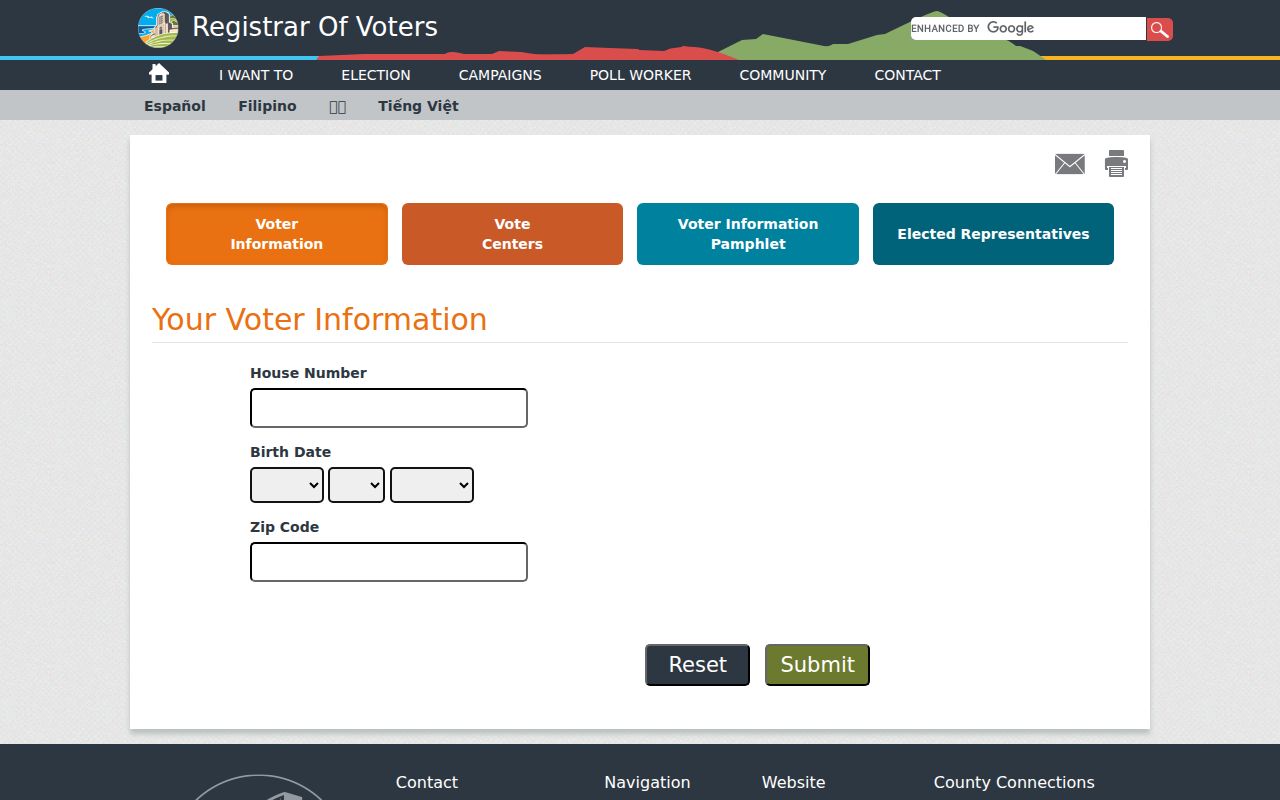
The voter form draws the same line. It requests residence details and a birth date. These confirm the identity of the person asking. A mismatch can point to an older address, a different ZIP, or a pending application. It may also mean someone outside the county. Nothing here converts the Chula Vista residents directory into a name-to-household database.
Chula Vista Permits After 1992
For current address records in Chula Vista, the Accela Citizen Access portal is hard to beat. Searching is free. No login is required. You only need an account to submit an application. Tabs sort permits into building, planning, and land development. Other tabs cover wireless and telecommunications, fire, right of way, and license categories. A result can show the record number, type, status, and address. It may also list the parcel, project description, related records, fees, and completed inspections.
The online permit and inspection history reaches back only to permits issued after 1992. Treat that date as a digitization cutoff. It is not the start of building in Chula Vista. Older building records come through a Development Services request. Have the property address, APN, permit number if known, and document type ready. Copies of building plans follow Health and Safety Code section 19851 procedures. Those procedures may call for owner or authorized-agent information. Anything not posted online can still go through the city public-records route as a fallback.
| Accela field | What to enter or expect |
|---|---|
| Search type | Address, Parcel Number, Owner Name, Permit Number, or Licensed Professional |
| Street fields | Number range, direction, street name, type, unit, city, state, and ZIP |
| Parcel number | Use the APN when the street address is ambiguous or has changed |
| Permit number | Use an exact or known record number when available |
| Result details | Status, dates, related records, inspections, project description, and listed professional |
A permit can place a person near an address at a point in time. It can also place a business there. The applicant, contractor, or licensed professional named on the permit is not automatically the owner. The same is true for the resident. For the Chula Vista residents directory, the permit record supplies useful chronology. It cannot replace the assessor, recorder, or occupants.
Note: A pre-1992 address needs a paper, archive, map, newspaper, or street directory source before a missing online permit counts as a gap.
Owner Versus Occupant in Chula Vista
Owner and occupant are different roles. It is the simplest warning in local research. The county separates situs, the physical parcel, from the mailing address that receives tax correspondence. A mailing address can be a post office box, trust, agent, second property, or another home. A homeowners' exemption hints at owner occupancy on a roll date. It still never lists every person in a household.
Each record answers a different question. A deed conveys an interest; a tax bill shows an account; a permit names project participants. A directory records the publisher's snapshot. The same name across all four persuades only when dates, middle initials, spouses, APN, legal description, and address transitions line up. Matching names alone prove nothing. That discipline keeps the Chula Vista residents directory grounded in records rather than assumptions.
| Official record trail | Compiled people-search result |
|---|---|
| Names the custodian, record type, date, and access limits | May merge records from several sources without showing provenance |
| Can be checked at an ARCC, city, court, library, or state office | May lag a correction or repeat an old address |
| Shows a narrow fact such as party, parcel, filing, or registration status | May imply a household relationship the source never established |
- Parcel
- A legally identified piece of land, usually connected to an APN.
- Situs
- The physical location of the parcel, distinct from the tax mailing address.
- Index
- A finding aid that names a record; it may not include the record image.
- Criss-cross directory
- An older address-first directory that links a street location to a householder or business entry.
Use the narrow fact. Chula Vista property and resident records support personal, lawful research. Do not use a record to stalk, harass, intimidate, or harm anyone.
Chula Vista Voter Lookup Limits
California voter information is not an open public directory. The county self-service form lets one voter check their own registration. It asks for house number, street name, street type, birth date, and ZIP. Directions are optional. A successful lookup can return status, party preference, districts, representatives, polling or vote-center details, a sample ballot, and mail-ballot status.
San Diego County also accepts a voter-data application. It requires an original signature, an exact permitted purpose, a defined scope, and a security plan. Email and fax submissions are not accepted. Approved files arrive encrypted or through controlled delivery instructions. The applicant may not reuse the file, share it without approval, publish it insecurely, or use it to harass any voter or household. Elections Code sections 2188 and 2194 set the access rules. Title 2 regulations, sections 19001 through 19013, complete them.
- House number and street name: required residence match.
- Date of birth: month, day, and year identity gate.
- Street type and directions: address refinement when present.
- ZIP code: required residence detail, not a ZIP-wide resident list.
- Party preference: appears in the lookup or results flow as context allows.
Voter files have real limits. A Chula Vista registration may show a name, residence, mailing address, and party preference, but sensitive identifiers and protected addresses stay withheld. Safe at Home participants use a substitute mailing address. Historical registers take more digging. Poll books and registers are requested by election and precinct from the Registrar, the County Archives, or the California State Archives, and no Chula Vista year run appears online.
Chula Vista Vital Copy Classes
Vital records answer basic questions. A birth, death, marriage, or divorce record can confirm an event or relationship. California opens no record under a simple age rule. County events go through San Diego ARCC's Chula Vista branch. Statewide routes come from the California Department of Public Health. Divorce decrees belong to the Superior Court. A CDPH divorce Certificate of Record is not a decree. It covers only specified historic dates.
Copy classes matter. Health and Safety Code sections 103526 and 103526.5 divide certified copies into authorized and informational classes. An authorized copy requires a qualifying relationship or purpose and a sworn statement. Informational copies reach more people. They may carry redactions and a legend stating the copy cannot establish identity. Confidential marriage records follow their own rule. Under Family Code section 511, the issuing county clerk releases them to a party. Otherwise the clerk releases them only by court order.
- Birth: ARCC or CDPH; county $34 and state $31 in the research fee schedule.
- Death: ARCC or CDPH; $26.
- Public marriage: ARCC or CDPH; $19.
- Confidential marriage: issuing county clerk, spouse, or court order; verify the current fee.
- Divorce Certificate of Record: CDPH form VS113B for limited dates; $18.
County birth copies come three ways. Order in person, by mail, or through VitalChek. A mailed authorized copy needs a notarized acknowledgment. The state route uses forms VS111, VS112, and VS113A. Applicants list the event, relationship, purpose, signature, payment, and mailing details, which is why a search may confirm an event exists without revealing every field.
Chula Vista Business Trails
A trade name can be a better first thread than a street address. Chula Vista's public business search links a name to a municipal license. It also matches account, category, or date range. The city warns that filers self-report the details, so accuracy is never guaranteed. For a current license, the active Business Finder is the right tool. To tie a trade name to a registrant's public filing fields, the county fictitious-business-name index does that work.
Corporations, limited liability companies, and limited partnerships live in the California Secretary of State's bizfile Online search. An entity number and type may come back. Status, formation or registration date, principal or mailing address, agent for service, and filed statements may appear too. Remember what an agent is. That role is a legal contact, not proof of ownership or residence. The Department of Consumer Affairs license search rounds things out with status, issue or expiration dates, a public address of record, and any discipline from the issuing board.
The California business-entity search is an official affiliation trail that should be read separately from a household record.
Keep the paperwork honest. Record the filing date, effective date, and role for every result. A business, license, FBN, or professional address may only mark a work, mailing, or service location. Such a record can still corroborate a name and a time period, then point the inquiry toward the custodian who holds what the question actually needs.
Other Chula Vista Public Indexes
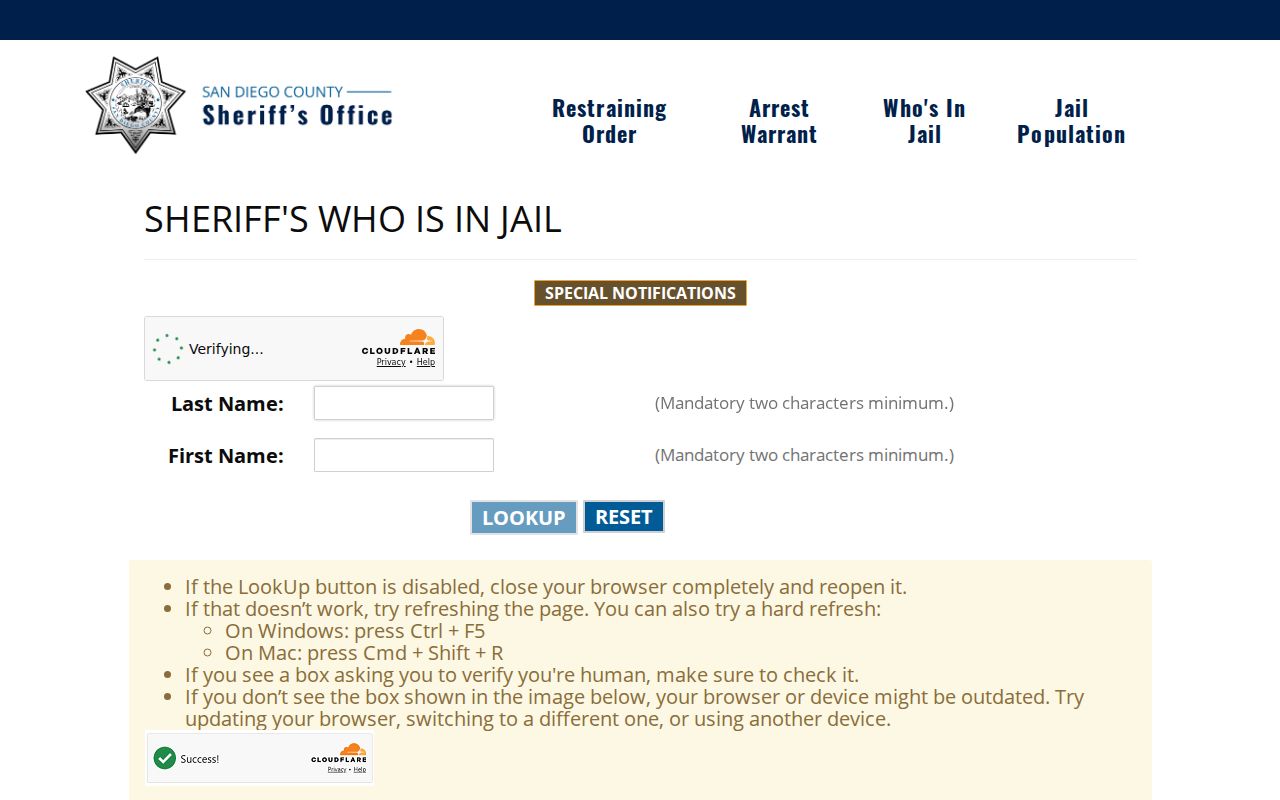
Some current indexes track custody or money instead of ordinary residence. The San Diego County Sheriff's Who's in Jail lookup is one such custody source. California's CDCR locator handles state prison records. The Megan's Law site is run by California DOJ. It offers a statutory public registry with name and map features. The State Controller's unclaimed-property search gives an official name lead, though a claim demands proof. None of these works as a complete Chula Vista residents directory.
The San Diego County Sheriff custody search illustrates a record with a narrow, changing purpose.
Statewide options widen the net. The Department of Consumer Affairs license search belongs on the list. SOS business filings and UCPI do too. California DOJ does not sell a public third-party name-based criminal-history check. A person can request their own state summary by fingerprint through the official process. An index that seems to name the wrong person calls for comparison, not repetition. Match dates and identifiers first. Check the originating office before any result earns a place in a new directory.
Note: A public index can be current for its own purpose. It may still say nothing about where someone lives now, who shares the household, or private relationships.
Chula Vista Memory and History
Historical resident research in Chula Vista starts at the John Rojas Local History Room. That room sits in the Civic Center Branch. Photographs, clippings, newspapers, directories, yearbooks, and local reference material all sit in that collection. Inside the library, Newspapers.com opens three papers. It covers the Otay Press, the Chula Vista Star, and the Chula Vista Star-News. Photos and yearbooks take an advance Local History Request Form emailed to localhistory@chulavistaca.gov. The library notes a wait of two to three weeks.
The Memory Lab carries the record trail past government files. Equipment and training let residents digitize family photographs, audio, and video. The federally supported project aims to add underrepresented stories to a community archive. Donor rights and public-access rules still apply. A contributed memory can supply a name, street, school, club, or date. Even so, weigh it against a dated directory, newspaper, deed, or another custodian source.
San Diego Central Library's California Collection adds city directories from 1886 through 2021. It also offers newspapers and maps. The Great Register from 1888 through 1892 is onsite too. San Diego Digital Archives offers a shorter online run. So the local history route runs digital and physical at once. Confirm appointment limits and shelf coverage before visiting. Those shelves hold the historical half of the Chula Vista residents directory.
Historical Chula Vista Directories
No single continuous city book exists for the historical Chula Vista residents directory. It is a chain of broader San Diego and suburban volumes instead. The City of San Diego Digital Archives holds an 1874 county directory. It also holds annual San Diego runs from 1926 through 1943, with later gaps. The archives add suburban volumes from 1955 through 1960, plus other digitized material. R.L. Polk & Co. appears in the 1956 and 1960 suburban books. Haines evidence covers 1971, 1975, 1979, 1982, and 1986. Later Polk and environmental-archive material reaches selected years from 1992 through 2017.
A 1923 entry can pair a name with a spouse, an occupation, and a home or rooming mark. It may add a street address, and sometimes a rural locator. The 1960 feature key adds homeowner or renter marks and telephone details. It also adds street intersections and business roles. Treat the marks as publisher conventions. They are not certificates. A directory year records a canvass or compilation, nothing more. People go missing for many reasons. They moved, died, married, or used another spelling. Some lived outside the coverage area. Others appeared under a larger suburban title.
For full collections, shelf locations, and sample entries, turn to the Chula Vista city directory collections. The same collections offer a year-by-year household method. The dependable sequence stays simple. Start with a name and address in a directory. Add an event-date census or newspaper entry. Bring in a deed, probate, or vital record when identity needs stronger proof.
Lawful history work. Family history, civic research, and reconnecting with a known community are appropriate uses. Respect protected addresses and stop when a record does not support further contact.