
Chula Vista Directory Collections
Chula Vista appears in a regional shelf. San Diego and county volumes, suburban issues, address-first books, newspapers, and local-history files all contribute to the city directory record. The publisher and title matter because a volume called San Diego Directory may cover county towns, while a suburban Polk book may organize Chula Vista separately. Coverage is not continuous. A blank year can mean no issue, a combined volume, an undigitized copy, or cataloging under a broader title.
| Collection | Years or Publisher | Where Held | Access |
|---|---|---|---|
| San Diego and county directories | 1874; annual 1926-43; 1944-45; 1947-48; 1950; 1952-54 | San Diego Digital Archives | Digitized PDFs |
| Suburban directories including Chula Vista | 1955-60; R.L. Polk in 1956 and 1960 | Digital Archives | Online scans |
| Address and criss-cross evidence | Haines 1971, 1975, 1979, 1982, 1986 | Environmental and EDR archive evidence | Verify edition and page |
| Later Polk/address evidence | 1960, 1965; selected 1992-2017 editions | City archive appendix and library leads | Reference or onsite research |
| Broad physical San Diego shelf | 1886-2021 | Central Library California Collection | Onsite special collections |
| Early digitized volumes | 1876-1925, scope varies | Internet Archive and SOHO guide | Verify volume coverage |
Start with the free Digital Archives PDFs when the year is covered. Use the Central Library for the long physical run, and contact Chula Vista Public Library staff before a local-history visit. The collection is a set of paths, not one static Chula Vista city directory.
Note: A San Diego title may contain Chula Vista pages, so search the broader volume before declaring a local year missing.
Reading Chula Vista Directory Entries
A Chula Vista city directory entry compresses a household into publisher shorthand. A 1923 page can show a surname, given name and initials, spouse in parentheses, an occupation or organization role, and a home or rooming mark. One example uses “h” for home and another uses “r” for rooms or residence. A widow notation may preserve a deceased spouse's initial. Street guides add intersections, numbered addresses, householder or business, homeowner or renter marks, and sometimes a telephone.
Read the alphabetical section and the street section together. Preserve the volume title, publisher, year, page or image, and abbreviation key. The key matters because a mark can reflect a publisher's practice rather than a legal fact. A directory is evidence of a listing, not proof of title, relationship, or continuous residence.
| Entry field | What it may mean |
|---|---|
| Name | Surname, given name, initials, spouse, or a married-name variation |
| Role or occupation | A business, civic, institutional, or work connection named by the publisher |
| Address | Numbered street, rural locator, or a street-guide placement |
| Home or rooming mark | Publisher shorthand such as h for home or r for rooms/residence |
| Householder marks | Homeowner, renter, business, or telephone notation in the street section |
- Criss-cross directory
- The address-first portion that works from a street and number toward a name.
- Householder index
- A finding aid organized around the person or household listed by the publisher.
- Abbreviation key
- The volume's guide to short forms, symbols, and the meaning of residence or business marks.
- Directory snapshot
- A dated compilation that can miss people, moves, or unlisted household members.
Relative rural syntax deserves extra care. A 1923 Chula Vista page may describe a home by direction and distance from a cross street. Translate that clue only after checking maps, deeds, and later address forms.
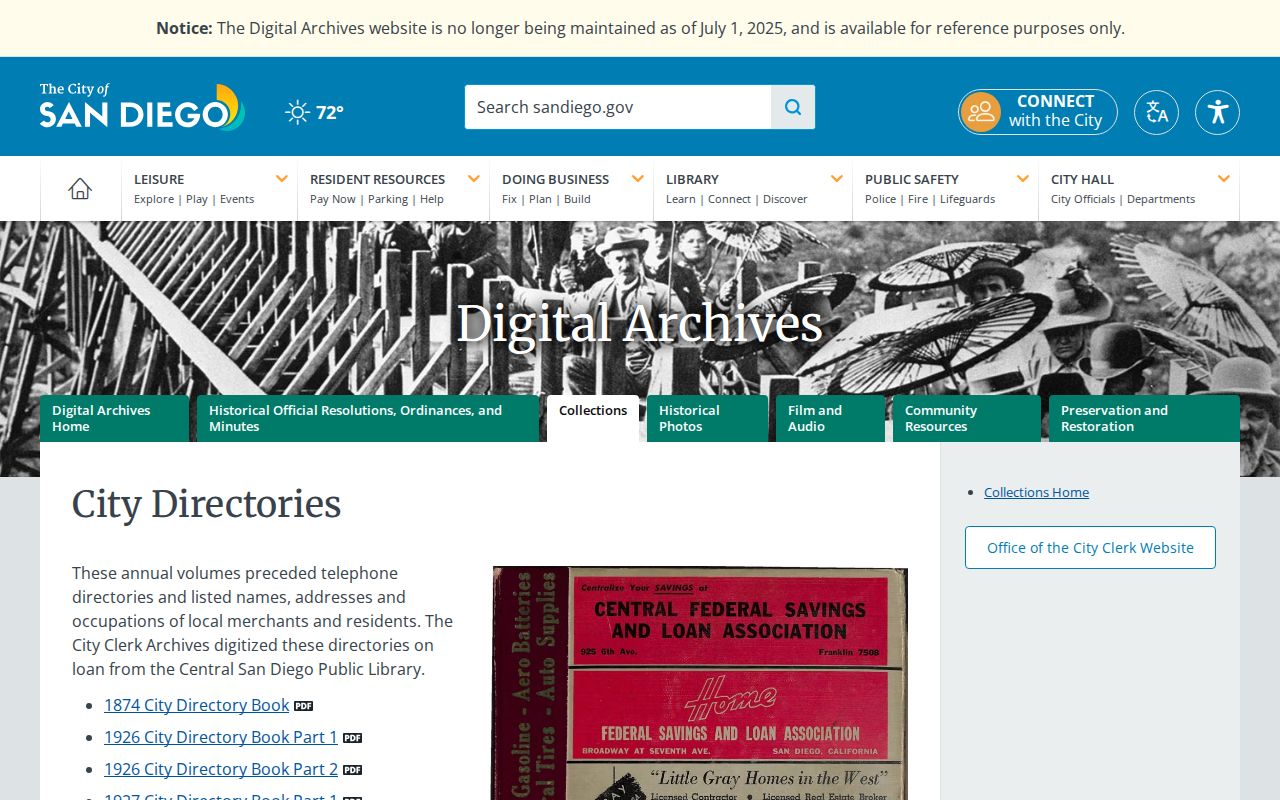
The San Diego Digital Archives directory collection provides the regional scan context for suburban Chula Vista entries.
Chula Vista's Directory History Room
The Chula Vista Public Library's John Rojas Local History Room is the local anchor for the city directory trail. The Civic Center Branch at 365 F Street holds reference material, photographs, clippings, newspapers, yearbooks, and local exhibits. The branch lists Monday through Thursday hours of 10 to 8, Friday and Saturday 10 to 5, and Sunday 1 to 5, but shelf access and special requests should be confirmed before travel.
Local-history staff can help identify a volume, a neighborhood name, or a collection that is not visible in a general catalog. Newspapers.com access in the library includes the Otay Press, Chula Vista Star, and Chula Vista Star-News. Photos and yearbooks need the Local History Request Form sent to localhistory@chulavistaca.gov, with two to three weeks allowed. Current restoration work means the Historical Images database may be offline, so a reference request can be more useful than a repeated search.
Chula Vista Digital Directory Runs
The San Diego Digital Archives city-directory collection is the first stop for covered years. Its regional run includes a 1874 county directory, annual San Diego issues from 1926 through 1943, combined or later issues in the 1940s and early 1950s, and suburban volumes from 1955 through 1960. The 1956 and 1960 suburban books identify R.L. Polk & Co. as publisher. A 1932 San Diego Directory Co. volume includes Chula Vista and county towns, with alphabetical, street, telephone, buyers, and classified sections.
The online scan may place Chula Vista under a San Diego or suburban title. Search the alphabetical pages manually when OCR fails, then check the street guide. A 1960 entry key can identify a resident or business, spouse, widow or deceased-spouse notation, role, homeowner or renter mark, and telephone. Record the PDF title and page rather than citing a search-result snippet.
Early volumes from 1876 through 1925 may be reached through Internet Archive or the SOHO research guide, but the exact scope needs verification. The SOHO historic-home method is useful for pairing directories with deeds, photographs, and an owner or occupant chronology.
Chula Vista Directory Shelf Access
The Central Library California Collection at 330 Park Boulevard expands the local shelf. Its research description lists more than 5,000 California books, San Diego Union issues from 1868, more than 800 maps, the Great Register from 1888 through 1892, and city directories from 1886 through 2021 for onsite use. The digital City Archives directory run covers 1925 through 1960. These are complementary channels, not duplicate holdings.
San Diego History Center archives add manuscript, club, business, and personal-paper finding aids. The center can be contacted at collections@sandiegohistory.org or 619-232-6203 extension 117. County Archives supplies deeds and maps. The California State Archives and National Archives help with naturalization, government, and census series. FamilySearch or Ancestry Library may expose digitized images, but record the collection title and coverage before relying on a hit.
For a modern address-keyed trail, move from the historical shelf to the Chula Vista street directory workflow. That keeps the city directory page focused on collections and interpretation.
Chula Vista Directory Gaps
Directories fill the years between census schedules, but each source has a different clock. Federal population schedules are public through 1950 as of 2026 because of the 72-year release rule. The 1960 schedule remains closed. A directory may reflect a publisher's canvass, while a census records a household on one date. Compare both instead of treating either one as a continuous register.
Newspapers can explain a gap through a wedding notice, obituary, school activity, club event, property advertisement, legal notice, or migration story. Search the Otay Press, Chula Vista Star, Star-News, and San Diego Union-Tribune with name variants, address, school, organization, and spouse. An obituary can connect married names and relatives, but user-contributed memorials remain leads until a newspaper, vital record, or probate filing supports them.
- 1874-1925 | Broader San Diego, county, and early digitized volumes require title and scope checks.
- 1926-1954 | Annual and combined San Diego runs bridge census dates and include county towns.
- 1955-1960 | Suburban R.L. Polk volumes make Chula Vista entries easier to isolate.
- 1971-1986 | Selected Haines address evidence supports reverse searching.
Chula Vista Directory Memory Lab
Chula Vista's Memory Lab adds a human layer to the city directory record. The IMLS-supported project acquired digitization equipment, trained staff and the public, and aims to preserve family photographs, audio, video, and underrepresented community stories. It can reveal a name on the back of a photograph, a street sign, a club program, or a family paper that never reached a government shelf.
Community-created material needs the same discipline as a directory. Ask what donor agreement controls public access, how the item is described, and whether a name or image can be reused. Pair the result with the library's newspaper collection, a directory page, a deed, a school yearbook, or an official event record. The Memory Lab preserves context; it does not create a public membership roll.
Note: Family collections are strongest when the image, caption, date, place, donor context, and independent record all point to the same person.
Tracing Chula Vista Directory Households
Use a Chula Vista city directory as a sequence of observations. Start with the clearest name and address, then follow spelling, spouse, role, and street changes through nearby editions. Pair 1940 and 1950 directories with the matching public census schedules. Use newspapers, deeds, probate, and vital records when the directory trail changes or ends. This method works for a family-history question, a former classmate, or the history of a known address without assuming that a missing entry proves a move.
- Find the first plausible alphabetical entry and record the exact name, spouse, role, address, volume, year, and page.
- Check the street guide for the same number, nearby entries, cross streets, and any householder mark.
- Move forward and backward through adjacent editions, testing maiden, married, compound, accented, and shortened name forms.
- Pair directory observations with the 1940 or 1950 census, then compare deeds, maps, and newspapers for address continuity.
- Close a death or disappearance with an obituary, probate case, cemetery lead, or vital-record route, subject to access rules.
A person can vanish from a volume because of a move, death, marriage-name change, missed canvass, missing issue, or inclusion under a larger suburban title. Occupation can help separate same names, but it also changes. A later deed or obituary anchors the identity more firmly than a repeated directory line.
Note: Write the volume and page beside every clue so a later reader can tell a directory observation from a verified event.